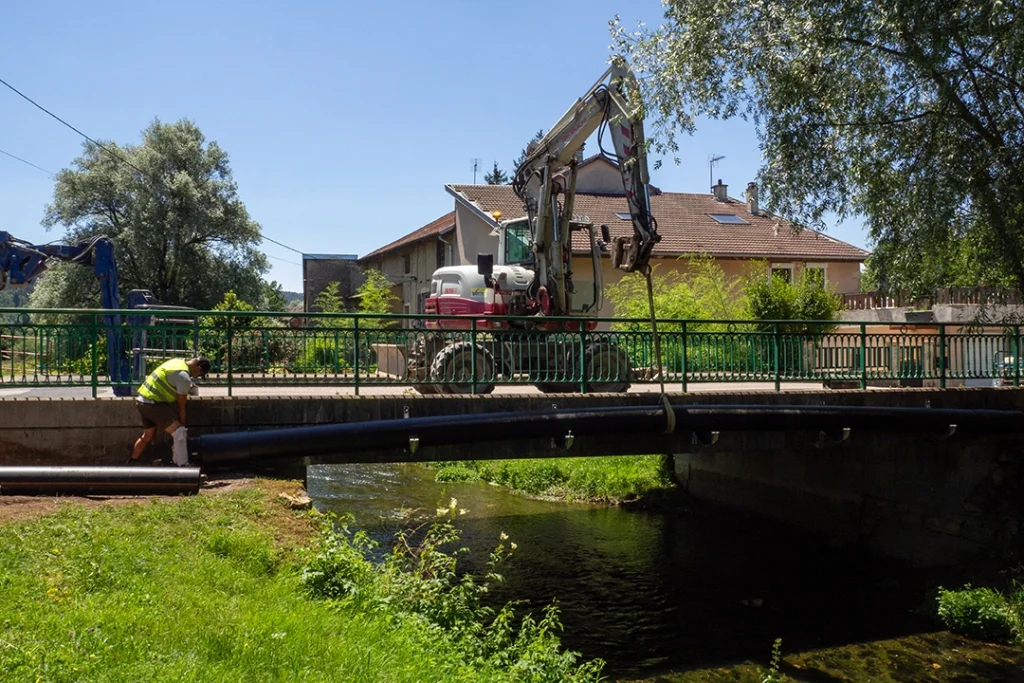
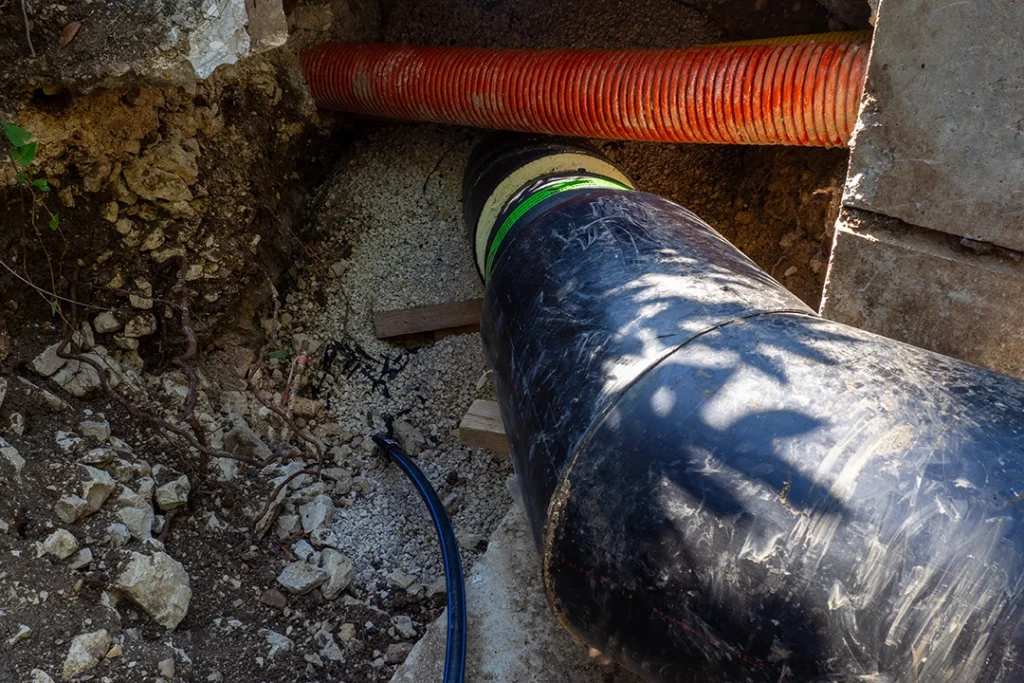
Dans le domaine des réseaux d’eau, l’encorbellement désigne une technique de construction où une canalisation est installée en saillie, dépassant du nu d’un mur ou d’une structure existante. Cette méthode est particulièrement utile pour les réseaux de refoulement des eaux usées, comme celui récemment mis en place à Martignat (01).
L'encorbellement dans les réseaux d'eau : Une solution pratique avec le PE100
Avantages de l’encorbellement pour les réseaux de refoulement :
L’encorbellement offre plusieurs avantages pour les réseaux de refoulement des eaux usées :
Adaptation au terrain : Il permet de surmonter des obstacles naturels -comme ici une rivière traversée par un pont- ou artificiels sans nécessiter d’excavations importantes.
Économie d’espace : La canalisation peut être installée sans empiéter sur le sol, ce qui est principalement appliqué dans les zones urbaines denses.
Facilité d’accès : L’installation en saillie facilite l’inspection et la maintenance du réseau.
Le PE100 : Un matériau de choix pour l'encorbellement
Le polyéthylène haute densité PE100 s’impose comme le matériau idéal pour les canalisations en encorbellement, notamment dans sa version pré-manchonnée. Voici pourquoi :
Résistance aux agresssions chimiques
Le PE100 offre une résistance améliorée aux désinfectants chlorés, même à des températures élevées. Cette caractéristique est cruciale pour les réseaux d’eaux usées, où les conditions d’exploitation peuvent être extrêmes.
Durabilité et robustesse
Ce matériau présente une excellente résistance aux chocs et aux fissurations lentes, ce qui garantit une longévité accrue des canalisations.
Facilité d’installation
Les tubes en PE100 peuvent être posés sans lit de sable, ce qui simplifie considérablement l’installation, en particulier dans les configurations en encorbellement.
Flexibilité de mise en œuvre
Disponible en barres de différentes longueurs (jusqu’à 12 mètres), le PE100 s’adapte parfaitement aux contraintes spécifiques des chantiers d’encorbellement.
Raccordement simplifié
La version pré-manchonnée facilite les raccordements, réduisant ainsi le temps d’installation et les risques de fuites.
Résistance aux agressions chimiques
Le PE100 offre une résistance totale aux agressions chimiques, un atout majeur pour les réseaux d’eaux usées.
L’utilisation du PE100 pour les canalisations en encorbellement représente une solution technique avancée pour les réseaux de refoulement des eaux usées. Sa combinaison unique de résistance, de durabilité et de facilité d’installation en fait un choix judicieux pour les projets d’infrastructure hydraulique modernes, comme celui réalisé à Martignat. Cette approche novatrice permet non seulement d’optimiser la gestion des eaux usées, mais aussi de réduire l’impact environnemental des chantiers tout en assurant une longévité accrue des installations.