
Elydan propose de vous accompagner dans la réalisation de votre projet d’installation géothermique. Notre accompagnement passe aussi par le guidage vers nos partenaires pour réaliser votre Test de Réponse Thermique.
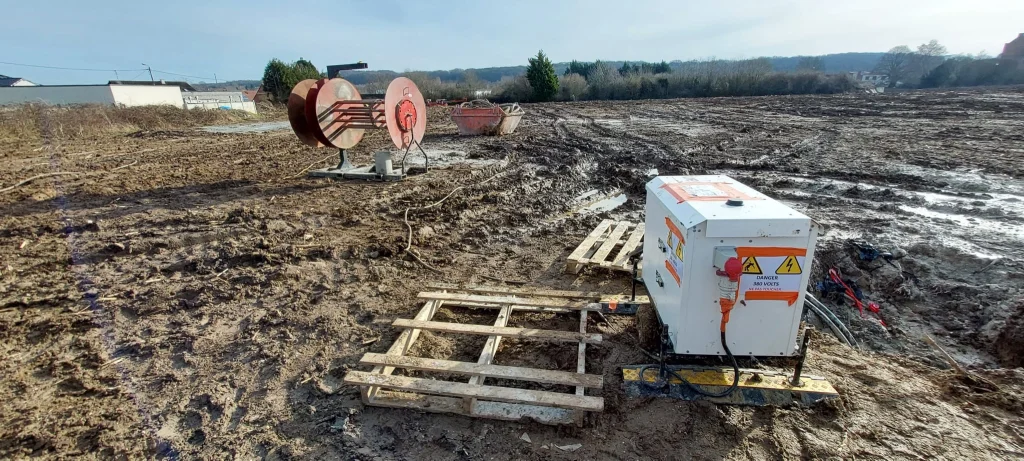
Elydan fait partie d’un grand réseau d’experts répartis dans toute la France et même au-delà des frontières.
Contribuer à la transition énergétique avec la géothermie
La géothermie représente une solution prometteuse pour la transition énergétique, car elle permet de réduire les émissions de CO2 en fournissant une énergie renouvelable et durable. Le Test de Réponse Thermique est un levier clé pour garantir que les installations géothermiques soient non seulement performantes, mais aussi adaptées aux besoins énergétiques actuels.
En faisant appel à Elydan pour réaliser un TRT, vous vous assurez d’être accompagné par des spécialistes qui sauront vous aiguiller au mieux et vous aideront également à obtenir les aides au financement.
Quand réaliser un TRT ?
La Réalisation d’un TRT est réalisée lors de la phase de conception d’un projet géothermique, avant les choix de la solution et son installation définitive. Il est particulièrement utile pour les projets de grande envergure, où les sondes géothermiques doivent fournir une énergie stable sur une longue période. Dans le cadre de projets résidentiels, commerciaux ou industriels, le TRT permet d’obtenir des garanties de performance avant de passer à la phase de construction.
Il est à noter que certains projets ne sont éligibles aux aides de financement de l’ADEME que sous des conditions particulières, notamment pour la réalisation du Test de Réponse Thermique. Nos experts seront capables de vous guider au mieux.
Je contacte mon expert
Pourquoi réaliser un Test de Réponse Thermique ?
Le TRT permet de comprendre avec précision comment la chaleur est transférée entre le sol et une sonde géothermique. Cela est essentiel pour concevoir des installations efficaces et durables. En réalisant ce test, il est possible de :
Calculer la conductivité thermique du sol : Connaître la capacité du sol à transférer la chaleur est crucial pour dimensionner correctement une installation géothermique. Un sol avec une bonne conductivité thermique permet d’améliorer la performance du système.
Optimiser le dimensionnement des sondes géothermiques : Le TRT aide à déterminer la profondeur et le nombre de sondes nécessaires pour un projet, réduisant ainsi les coûts d’installation et maximisant l’efficacité énergétique.
Assurer la longévité du système : En comprenant la dynamique thermique du sol, il est possible de prévenir les déséquilibres thermiques qui pourraient nuire à la performance à long terme du système géothermique.
Comment fonctionne un TRT ?
Le Test de Réponse Thermique se déroule en plusieurs étapes :
Installation de la sonde géothermique : Avant de commencer le test, une sonde est installée dans un forage, souvent à plusieurs dizaines de mètres de profondeur, étudié selon les paramètres du projet.
Injection de chaleur contrôlée : Un fluide caloporteur est injecté et circule dans la sonde à une température contrôlée. Pendant plusieurs heures, une quantité définie de chaleur est injectée dans le sol.
Mesure de la température : Pendant le test, des capteurs mesurent continuellement la température du fluide en circulation à l’entrée et à la sortie de la sonde. Ces données permettent de suivre la réponse thermique du sol.
Analyse des résultats : Les données collectées sont ensuite analysées pour déterminer la conductivité thermique du sol et la capacité thermique volumique. Ces informations sont essentielles pour calibrer le dimensionnement des sondes géothermiques.
Les avantages du TRT dans les projets géothermiques
Fiabilité des données : En fournissant des mesures précises sur le comportement thermique du sol, le TRT permet de garantir que l’installation géothermique sera adaptée aux conditions réelles du site.
Économies d’énergie : Un système correctement dimensionné grâce au TRT peut offrir des économies significatives sur la consommation d’énergie, notamment en évitant les pertes thermiques.
Réduction des coûts d’installation : Le TRT aide à éviter le surdimensionnement des installations, ce qui pourrait entraîner des coûts inutiles. Grâce aux données précises, il est possible d’ajuster le nombre de forages nécessaires pour chaque projet.